Deep Learning for Retinopathy Detection
Develop and optimize deep learning models for accurate detection and classification of diabetic retinopathy from retinal images.
Enhancing Diabetic Retinopathy Management through Advanced Predictive Models and Patient-Centric Technologies
Learn More
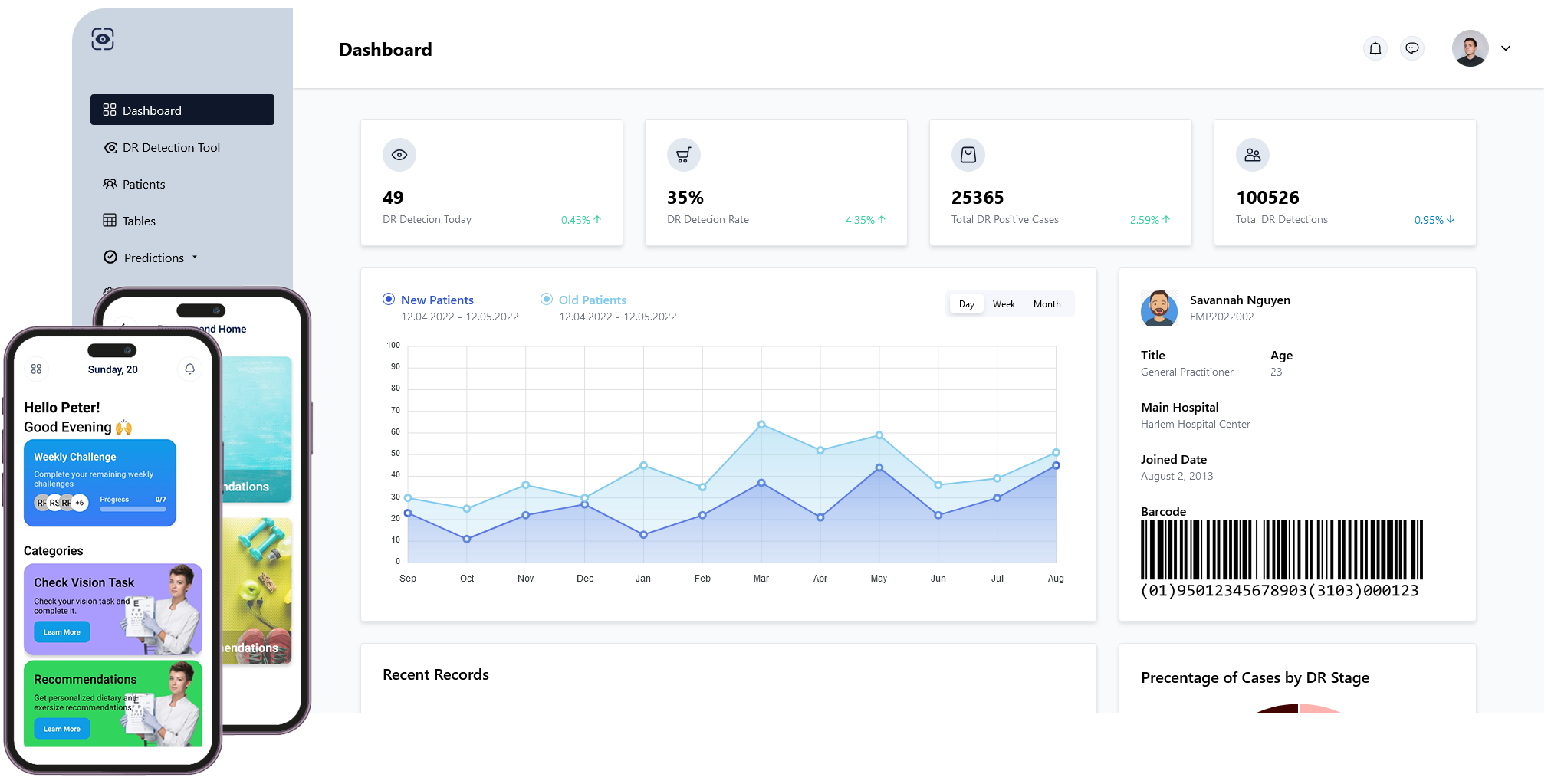
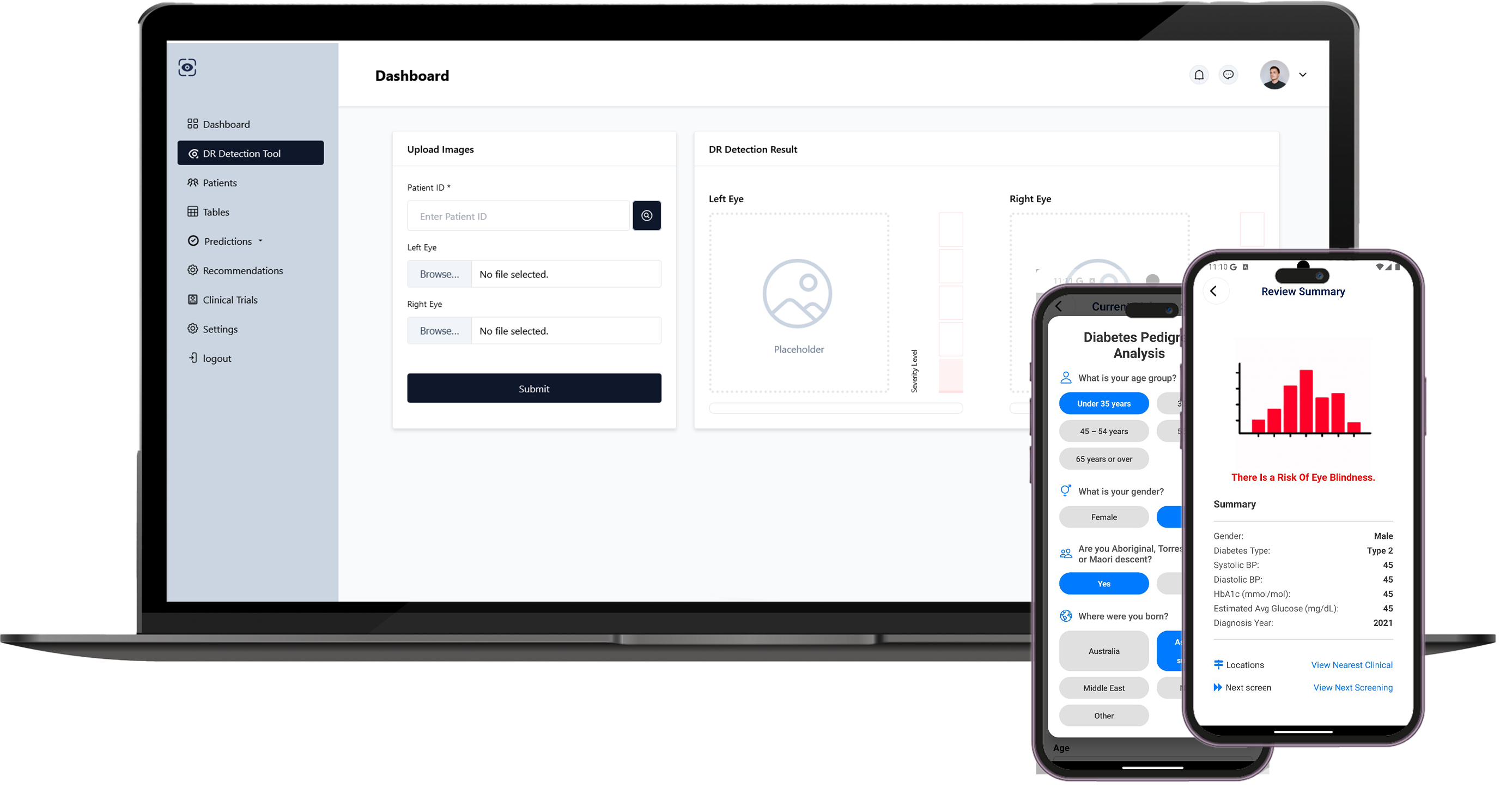


Our research focuses on enhancing diabetic retinopathy management through advanced predictive models and patient-centric technologies. We aim to address the critical challenges in early detection and management of diabetic retinopathy, a leading cause of vision loss among diabetic patients worldwide.
Our comprehensive platform aims to bridge the gap in eye care accessibility, particularly in underserved areas, by providing tools for diagnosis, management, and early intervention in diabetic retinopathy.
Our research addresses critical challenges in diabetic retinopathy management and detection.
Lack of eye surgeons and specialists leads to difficulties in manually assessing each color fundus retinal photograph for diabetic retinopathy diagnosis.
Patients in rural areas face challenges in obtaining color fundus photographs crucial for diagnosis, limiting their access to proper care.
Improper management of exercise and diet has emerged as a leading cause of deteriorating diabetic retinopathy among patients.
Diabetic retinopathy often progresses unnoticed due to gradual vision loss, and current methods fail to detect it early, increasing the risk of severe impairment.
Our comprehensive platform aims to revolutionize diabetic retinopathy management through the following key objectives:

Develop and optimize deep learning models for accurate detection and classification of diabetic retinopathy from retinal images.

Enhance diabetic retinopathy management through personalized recommendations using reinforcement learning techniques.

Create an interactive vision monitoring system with alert mechanisms for early detection of vision changes in diabetic patients.

Develop machine learning models to predict the risk of diabetic retinopathy using clinical data, without relying on retinal images.
The research methodology for improving Diabetic Retinopathy (DR) management through advanced predictive models involves a comprehensive approach, from data collection to model evaluation. Using two key datasets, APTOS 2019 and Retinopathy 2015, the study prepares retinal images through preprocessing steps like resizing, normalizing, and data augmentation. A DenseNet-based Convolutional Neural Network (CNN) is employed for its effective feature extraction capabilities. Transfer learning with pre-trained models, such as EfficientNet and MobileNet, is used to boost model performance. The model is trained with the Adam optimizer, monitoring key metrics like accuracy, precision, recall, and F1-score. The research adopts a microservices architecture, using Docker for containerization and Kubernetes for orchestration, ensuring scalability and efficient resource management. The evaluation process tests the model on a separate validation set and compares it to existing solutions. This methodology combines cutting-edge deep learning and scalable system design to enhance DR detection and management in clinical settings.
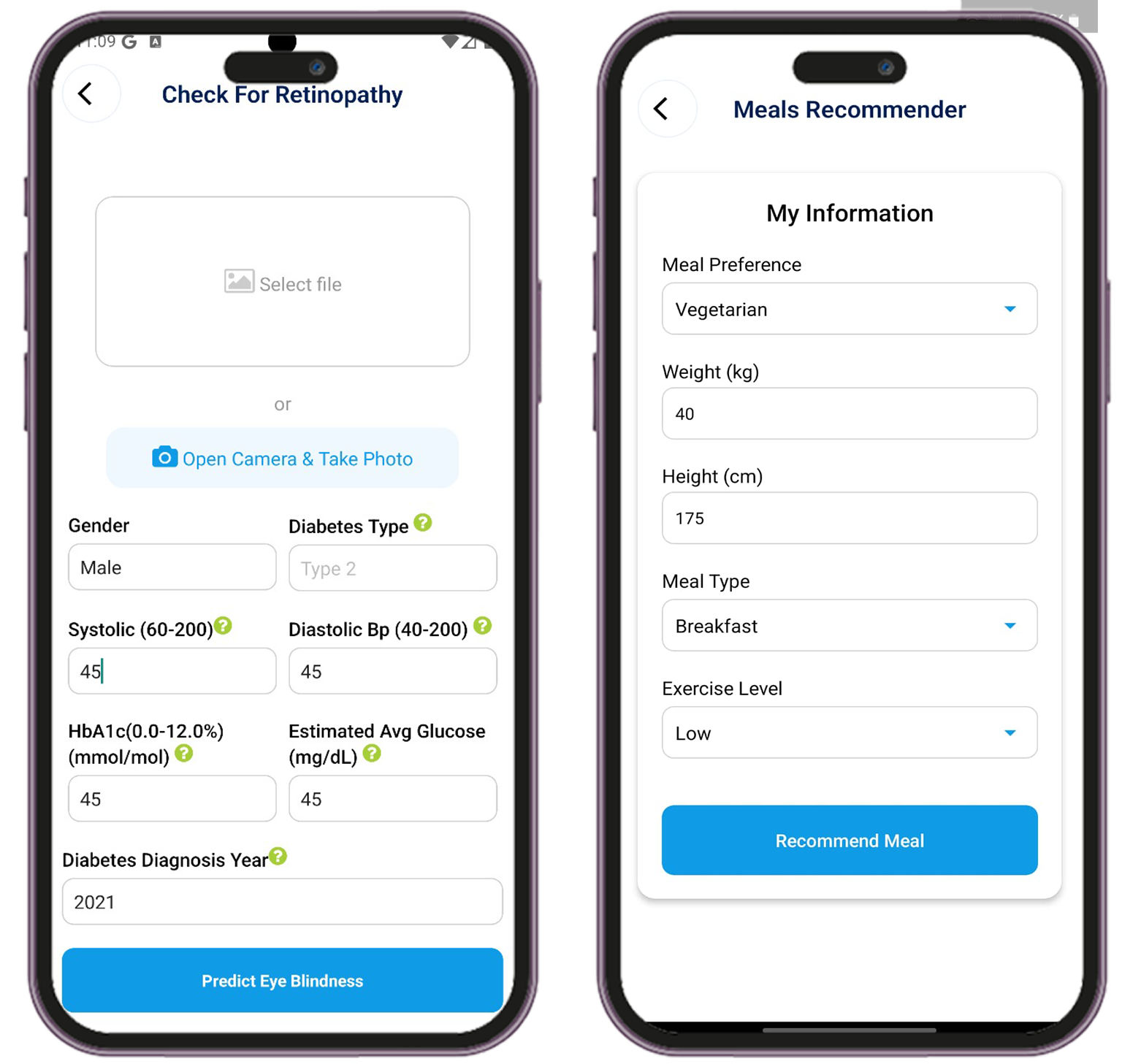
The “Retina-care” mobile app, developed using React Native, integrates a personalized dietary and exercise recommender system for diabetic retinopathy management. The dietary recommendation system utilizes Q-learning and an expert system to generate personalized meal plans based on user conditions such as activeness and dietary preferences. Each patient’s state is defined by a combination of conditions, and diet plans serve as actions. Initially, a Q-table is generated for each user, which is updated through reinforcement learning based on feedback from the user. The cold start problem was addressed by implementing three solutions: the epsilon-greedy method, initialized Q-tables, and integrating an expert system. Ultimately, the expert system was preferred due to ethical concerns with random actions in a medical context. The system tracks cumulative rewards to adjust recommendations based on user feedback. Doctors can also add new meal plans, dynamically updating the Q-tables. For exercise recommendations, a more generic expert system was implemented, offering suggestions based on medical factors. The system ensures a balance between medical appropriateness and user preferences. The framework could be adapted for other medical applications, such as autism management.
Developing a mobile application, RetinaCare Plus, to enhance the self-monitoring and management of diabetic retinopathy (DR). It uses a multi-phase approach, integrating technology with user-centered design. Key stages include designing gamified and personalized vision tests, and developing a monitoring dashboard. The system will undergo usability testing, clinical validation, and user experience refinement to ensure accessibility, accuracy, and clinical effectiveness. The impact of gamification and personalization on user engagement and adherence will also be assessed, aiming to improve the management of DR for both patients and healthcare providers.
The system uses a mobile app to capture medical reports, employing OCR to extract data. This information is sent to a backend server for processing. Machine learning models, including an RNN, predict diabetes and diabetic retinopathy risks. Results are displayed to users and stored in a database. For high-risk cases, the system uses Google Maps API to suggest nearby clinics. The architecture includes user authentication, data management, and notification services. A web application allows doctors to monitor patient data. The system is designed for scalability, using cloud storage, load balancing, and auto-scaling to handle varying traffic levels.










Explore our comprehensive collection of reports and presentations, showcasing the essence of our projects and research endeavors.
Our dedicated team, consisting of a supervisor, a co-supervisor, and four enthusiastic members, collaborated to achieve outstanding results.

Supervisor
Department of Information Technology
Sri Lanka Institute of Information Technology

Co-Supervisor
Department of Information Technology
Sri Lanka Institute of Information Technology
it21041648@my.sliit.lk
Department of Information Technology
Sri Lanka Institute of Information Technology

it21084690@my.sliit.lk
Department of Information Technology
Sri Lanka Institute of Information Technology

it21024368@my.sliit.lk
Department of Information Technology
Sri Lanka Institute of Information Technology

it19143200@my.sliit.lk
Department of Information Technology
Sri Lanka Institute of Information Technology

